

How Supercode Works
Supercode extends the AI agent already built into your IDE. It connects to capabilities that regular VS Code extensions cannot access, then adds its own workflow, context, voice, and catalog features directly to the agent experience.
Because Supercode works inside the IDE agent flow, it can improve prompts, add context before a turn, run managed workflows, expose custom buttons, and integrate with the active model and mode without replacing the IDE's native chat.
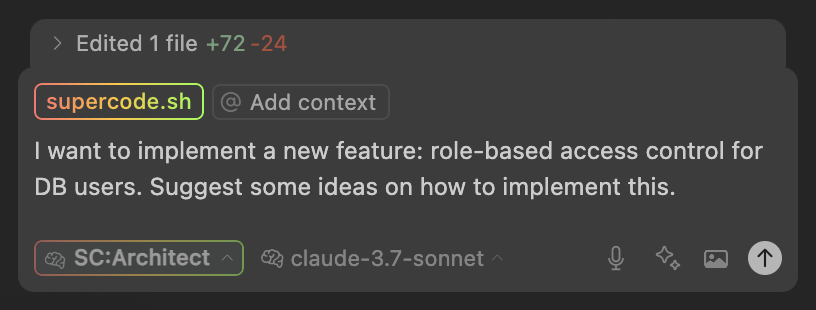
Current feature areas
- Automation: Workflows and Actions can transform prompts, run commands, call external services, and execute multi-step agent flows.
- Input: Voice Input and Prompt Enhancement help you create detailed requests faster.
- Context and tokens: Context Boosting supplies relevant project context, while Token Optimization reduces unnecessary terminal output.
- Reusable knowledge: the Skills Catalog adds specialized agent capabilities, while Specs & Docs provides focused documentation workflows.
Settings and project context
Open Supercode → Settings to manage your account, voice input, Actions, Workflows, and Token Optimization. Actions, Workflows, and custom modes can also be stored as JSON or YAML under the project's .supercode directory so teams can version and share them.
Eligible accounts can initialize a project to create .supercode/def.json. Supercode uses that compact project definition when a server-backed feature needs information about the current technology stack.
Compatibility
Supercode supports current Cursor and Antigravity integrations, but individual features can depend on the capabilities exposed by the active IDE version. Keep both the IDE and Supercode updated; unavailable integrations are disabled instead of blocking unrelated Supercode features.